

[Feb-2024] CS0-003 Dumps PDF - CS0-003 Real Exam Questions Answers
CS0-003 Dumps 100% Pass Guarantee With Latest Demo
CompTIA Cybersecurity Analyst (CySA+) Certification is one of the most in-demand certifications for cybersecurity analysts. CompTIA Cybersecurity Analyst (CySA+) Certification Exam certification exam has been designed to validate the aptitude of cybersecurity analysts in configuring and using threat detection techniques. It is an internationally recognized certification that demonstrates an individual's expertise in cybersecurity. CompTIA Cybersecurity Analyst (CySA+) Certification Exam certification exam is called CompTIA CS0-003.
CompTIA Cybersecurity Analyst (CySA+) Certification Exam, also known as the CS0-003 exam, is a certification that assesses an individual's knowledge and skills in cybersecurity analytics, threat management, and response. CompTIA Cybersecurity Analyst (CySA+) Certification Exam certification is intended for professionals who want to advance their careers in the field of cybersecurity and become Cybersecurity Analysts. CompTIA Cybersecurity Analyst (CySA+) Certification Exam certification is globally recognized and is ideal for individuals who are looking to validate their skills and knowledge in the field of cybersecurity.
CompTIA CS0-003, also known as the CompTIA Cybersecurity Analyst (CySA+) Certification exam, is a globally recognized certification designed to validate the skills and knowledge required to perform intermediate-level cybersecurity analysis. CompTIA Cybersecurity Analyst (CySA+) Certification Exam certification helps IT professionals to advance their career in cybersecurity by demonstrating their expertise in identifying and addressing security threats and vulnerabilities.
NEW QUESTION # 64
A recent penetration test discovered that several employees were enticed to assist attackers by visiting specific websites and running downloaded files when prompted by phone calls. Which of the following would best address this issue?
- A. Disabling all staff members' ability to run downloaded applications
- B. Blocking all scripts downloaded from the internet
- C. Ensuring that malicious websites cannot be visited
- D. Increasing training and awareness for all staff
Answer: D
Explanation:
Increasing training and awareness for all staff is the best way to address the issue of employees being enticed to assist attackers by visiting specific websites and running downloaded files when prompted by phone calls. This issue is an example of social engineering, which is a technique that exploits human psychology and behavior to manipulate people into performing actions or divulging information that benefit the attackers. Social engineering can take many forms, such as phishing, vishing, baiting, quid pro quo, or impersonation. The best defense against social engineering is to educate and train the staff on how to recognize and avoid common social engineering tactics, such as:
Verifying the identity and legitimacy of the caller or sender before following their instructions or clicking on any links or attachments Being wary of unsolicited or unexpected requests for information or action, especially if they involve urgency, pressure, or threats Reporting any suspicious or anomalous activity to the security team or the appropriate authority Following the organization's policies and procedures on security awareness and best practices Official Reference:
https://partners.comptia.org/docs/default-source/resources/comptia-cysa-cs0-002-exam-objectives
https://www.comptia.org/certifications/cybersecurity-analyst
https://www.comptia.org/blog/the-new-comptia-cybersecurity-analyst-your-questions-answered
NEW QUESTION # 65
A security analyst is trying to detect connections to a suspicious IP address by collecting the packet captures from the gateway. Which of the following commands should the security analyst consider running?
- A. strings packets.pcap | grep [IP Address]
- B. grep [IP address] packets.pcap
B cat packets.pcap | grep [IP Address] - C. tcpdump -n -r packets.pcap host [IP address]
Answer: C
Explanation:
tcpdump is a command-line tool that can capture and analyze network packets from a given interface or file. The -n option prevents tcpdump from resolving hostnames, which can speed up the analysis. The -r option reads packets from a file, in this case packets.pcap. The host [IP address] filter specifies that tcpdump should only display packets that have the given IP address as either the source or the destination. This command can help the security analyst detect connections to a suspicious IP address by collecting the packet captures from the gateway. Official Reference:
https://partners.comptia.org/docs/default-source/resources/comptia-cysa-cs0-002-exam-objectives
https://www.techtarget.com/searchsecurity/quiz/Sample-CompTIA-CySA-test-questions-with-answers
https://www.reddit.com/r/CompTIA/comments/tmxx84/passed_cysa_heres_my_experience_and_how_i_studied/
NEW QUESTION # 66
A company brings in a consultant to make improvements to its website. After the consultant leaves. a web developer notices unusual activity on the website and submits a suspicious file containing the following code to the security team: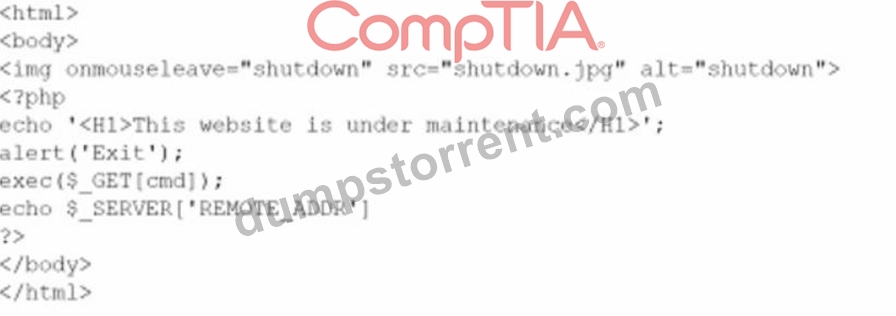
Which of the following did the consultant do?
Implanted a backdoor
Implemented privilege escalation
Implemented clickjacking
Patched the web server
Answer:
Explanation:
Implanted a backdoor.
A backdoor is a method that allows an unauthorized user to access a system or network without the permission or knowledge of the owner. A backdoor can be installed by exploiting a software vulnerability, by using malware, or by physically modifying the hardware or firmware of the device. A backdoor can be used for various malicious purposes, such as stealing data, installing malware, executing commands, or taking control of the system.
In this case, the consultant implanted a backdoor in the website by using an HTML and PHP code snippet that displays an image of a shutdown button and an alert message that says "Exit". However, the code also echoes the remote address of the server, which means that it sends the IP address of the visitor to the attacker. This way, the attacker can identify and target the visitors of the website and use their IP addresses to launch further attacks or gain access to their devices.
The code snippet is an example of a clickjacking attack, which is a type of interface-based attack that tricks a user into clicking on a hidden or disguised element on a webpage. However, clickjacking is not the main goal of the consultant, but rather a means to implant the backdoor. Therefore, option C is incorrect.
Option B is also incorrect because privilege escalation is an attack technique that allows an attacker to gain higher or more permissions than they are supposed to have on a system or network. Privilege escalation can be achieved by exploiting a software vulnerability, by using malware, or by abusing misconfigurations or weak access controls. However, there is no evidence that the consultant implemented privilege escalation on the website or gained any elevated privileges.
Option D is also incorrect because patching is a process of applying updates to software to fix errors, improve performance, or enhance security. Patching can prevent or mitigate various types of attacks, such as exploits, malware infections, or denial-of-service attacks. However, there is no indication that the consultant patched the web server or improved its security in any way.
Explanation:
The correct answer is
Reference:
1 What Is a Backdoor & How to Prevent Backdoor Attacks (2023)
2 What is Clickjacking? Tutorial & Examples | Web Security Academy
3 What Is Privilege Escalation and How It Relates to Web Security | Acunetix
4 What Is Patching? | Best Practices For Patch Management - cWatch Blog
NEW QUESTION # 67
A SOC analyst identifies the following content while examining the output of a debugger command over a client-server application:
getconnection (database01, "alpha " , "AXTV. 127GdCx94GTd") ;
Which of the following is the most likely vulnerability in this system?
- A. Buffer overflow attacks
- B. SQL injection
- C. Lack of input validation
- D. Hard-coded credential
Answer: D
Explanation:
Explanation
The most likely vulnerability in this system is hard-coded credential. Hard-coded credential is a practice of embedding or storing a username, password, or other sensitive information in the source code or configuration file of a system or application. Hard-coded credential can pose a serious security risk, as it can expose the system or application to unauthorized access, data theft, or compromise if the credential is discovered or leaked by an attacker. Hard-coded credential can also make it difficult to change or update the credential if needed, as it may require modifying the code or file and redeploying the system or application.
NEW QUESTION # 68
A security analyst is performing vulnerability scans on the network. The analyst installs a scanner appliance, configures the subnets to scan, and begins the scan of the network. Which of the following would be missing from a scan performed with this configuration?
- A. Operating system version
- B. IP address
- C. Open ports
- D. Registry key values
Answer: D
Explanation:
Registry key values would be missing from a scan performed with this configuration, as the scanner appliance would not have access to the Windows Registry of the scanned systems. The Windows Registry is a database that stores configuration settings and options for the operating system and installed applications. To scan the Registry, the scanner would need to have credentials to log in to the systems and run a local agent or script. The other items would not be missing from the scan, as they can be detected by the scanner appliance without credentials. Operating system version can be identified by analyzing service banners or fingerprinting techniques. Open ports can be discovered by performing a port scan or sending probes to common ports. IP address can be obtained by resolving the hostname or using network discovery tools. https://attack.mitre.org/techniques/T1112/
NEW QUESTION # 69
A security analyst is reviewing a packet capture in Wireshark that contains an FTP session from a potentially compromised machine. The analyst sets the following display filter: ftp. The analyst can see there are several RETR requests with 226 Transfer complete responses, but the packet list pane is not showing the packets containing the file transfer itself. Which of the following can the analyst perform to see the entire contents of the downloaded files?
- A. Navigate to the File menu and select FTP from the Export objects option
- B. Change the display filter to f cp-daca and follow the TCP streams
- C. Change the display filter to f cp. accive. pore
- D. Change the display filter to tcg.port=20
Answer: B
Explanation:
Explanation
The best way to see the entire contents of the downloaded files in Wireshark is to change the display filter to ftp-data and follow the TCP streams. FTP-data is a protocol that is used to transfer files between an FTP client and server using TCP port 20. By filtering for ftp-data packets and following the TCP streams, the analyst can see the actual file data that was transferred during the FTP session
NEW QUESTION # 70
During a recent site survey. an analyst discovered a rogue wireless access point on the network. Which of the following actions should be taken first to protect the network while preserving evidence?
- A. Disconnect the access point from the network
- B. Identify who is connected to the access point and attempt to find the attacker.
- C. Connect to the access point and examine its log files.
- D. Run a packet sniffer to monitor traffic to and from the access point.
Answer: A
Explanation:
The correct answer is D. Disconnect the access point from the network.
A rogue access point is a wireless access point that has been installed on a network without the authorization or knowledge of the network administrator. A rogue access point can pose a serious security risk, as it can allow unauthorized users to access the network, intercept network traffic, or launch attacks against the network or its devices1234.
The first action that should be taken to protect the network while preserving evidence is to disconnect the rogue access point from the network. This will prevent any further damage or compromise of the network by blocking the access point from communicating with other devices or users. Disconnecting the rogue access point will also preserve its state and configuration, which can be useful for forensic analysis and investigation. Disconnecting the rogue access point can be done physically by unplugging it from the network port or wirelessly by disabling its radio frequency5.
The other options are not the best actions to take first, as they may not protect the network or preserve evidence effectively.
Option A is not the best action to take first, as running a packet sniffer to monitor traffic to and from the access point may not stop the rogue access point from causing harm to the network. A packet sniffer is a tool that captures and analyzes network packets, which are units of data that travel across a network. A packet sniffer can be useful for identifying and troubleshooting network problems, but it may not be able to prevent or block malicious traffic from a rogue access point. Moreover, running a packet sniffer may require additional time and resources, which could delay the response and mitigation of the incident5.
Option B is not the best action to take first, as connecting to the access point and examining its log files may not protect the network or preserve evidence. Connecting to the access point may expose the analyst's device or credentials to potential attacks or compromise by the rogue access point. Examining its log files may provide some information about the origin and activity of the rogue access point, but it may also alter or delete some evidence that could be useful for forensic analysis and investigation. Furthermore, connecting to the access point and examining its log files may not prevent or stop the rogue access point from continuing to harm the network5.
Option C is not the best action to take first, as identifying who is connected to the access point and attempting to find the attacker may not protect the network or preserve evidence. Identifying who is connected to the access point may require additional tools or techniques, such as scanning for wireless devices or analyzing network traffic, which could take time and resources away from responding and mitigating the incident. Attempting to find the attacker may also be difficult or impossible, as the attacker may use various methods to hide their identity or location, such as encryption, spoofing, or proxy servers. Moreover, identifying who is connected to the access point and attempting to find the attacker may not prevent or stop the rogue access point from causing further damage or compromise to the network5.
Reference:
1 CompTIA Cybersecurity Analyst (CySA+) Certification Exam Objectives
2 Cybersecurity Analyst+ - CompTIA
3 CompTIA CySA+ CS0-002 Certification Study Guide
4 CertMaster Learn for CySA+ Training - CompTIA
5 How to Protect Against Rogue Access Points on Wi-Fi - Byos
6 Wireless Access Point Protection: 5 Steps to Find Rogue Wi-Fi Networks ...
7 Rogue Access Point - Techopedia
8 Rogue access point - Wikipedia
9 What is a Rogue Access Point (Rogue AP)? - Contextual Security
NEW QUESTION # 71
A security analyst is logged on to a jump server to audit the system configuration and status. The organization's policies for access to and configuration of the jump server include the following:
* No network access is allowed to the internet.
* SSH is only for management of the server.
* Users must utilize their own accounts, with no direct login as an administrator.
* Unnecessary services must be disabled.
The analyst runs netstar with elevated permissions and receives the following output: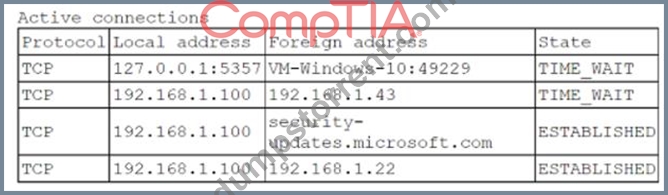
Which of the following policies does the server violate?
- A. Users must utilize their own accounts, with no direct login as an administrator.
- B. SSH is only for management of the server.
- C. No network access is allowed to the internet.
- D. Unnecessary services must be disabled.
Answer: C
Explanation:
The server violates the policy of no network access to the internet because it has an established connection to an external IP address (216.58.194.174) on port 443, which is used for HTTPS traffic. This indicates that the server is communicating with a web server on the internet, which is not allowed by the policy. The other policies are not violated because SSH is only used for management of the server (not for accessing other devices), users are utilizing their own accounts (not logging in as an administrator), and unnecessary services are not enabled (only SSH and HTTPS are running). Reference: CompTIA Cybersecurity Analyst (CySA+) Certification Exam Objectives (CS0-002), page 9; https://en.wikipedia.org/wiki/Jump_server
NEW QUESTION # 72
An organization implemented an extensive firewall access-control blocklist to prevent internal network ranges from communicating with a list of IP addresses of known command-and-control domains A security analyst wants to reduce the load on the firewall. Which of the following can the analyst implement to achieve similar protection and reduce the load on the firewall?
- A. An inline IDS
- B. IP address allow list
- C. DNS sinkholing
- D. A DLP system
Answer: C
Explanation:
DNS sinkholing is a mechanism that can prevent internal network ranges from communicating with a list of IP addresses of known command-and-control domains by returning a false or controlled IP address for those domains. This can reduce the load on the firewall by intercepting the DNS requests before they reach the firewall and diverting them to a sinkhole server. The other options are not relevant or effective for this purpose. Reference: CompTIA Cybersecurity Analyst (CySA+) Certification Exam Objectives (CS0-002), page 9; https://www.enisa.europa.eu/topics/incident-response/glossary/dns-sinkhole
NEW QUESTION # 73
After completing a review of network activity. the threat hunting team discovers a device on the network that sends an outbound email via a mail client to a non-company email address daily at 10:00 p.m. Which of the following is potentially occurring?
- A. Data exfiltration
- B. Rogue device on the network
- C. Abnormal OS process behavior
- D. Irregular peer-to-peer communication
Answer: A
Explanation:
Data exfiltration is the theft or unauthorized transfer or movement of data from a device or network. It can occur as part of an automated attack or manually, on-site or through an internet connection, and involve various methods. It can affect personal or corporate data, such as sensitive or confidential information. Data exfiltration can be prevented or detected by using compression, encryption, authentication, authorization, and other controls1 The network activity shows that a device on the network is sending an outbound email via a mail client to a non-company email address daily at 10:00 p.m. This could indicate that the device is compromised by malware or an insider threat, and that the email is used to exfiltrate data from the network to an external party. The email could contain attachments, links, or hidden data that contain the stolen information. The timing of the email could be designed to avoid detection by normal network monitoring or security systems.
NEW QUESTION # 74
The Chief Executive Officer of an organization recently heard that exploitation of new attacks in the industry was happening approximately 45 days after a patch was released. Which of the following would best protect this organization?
- A. A mean time to detect of 45 days
- B. A mean time to remediate of 30 days
- C. A mean time to respond of 15 days
- D. Third-party application testing
Answer: B
Explanation:
Explanation
A mean time to remediate (MTTR) is a metric that measures how long it takes to fix a vulnerability after it is discovered. A MTTR of 30 days would best protect the organization from the new attacks that are exploited 45 days after a patch is released, as it would ensure that the vulnerabilities are fixed before they are exploited
NEW QUESTION # 75
During the forensic analysis of a compromised machine, a security analyst discovers some binaries that are exhibiting abnormal behaviors. After extracting the strings, the analyst finds unexpected content. Which of the following is the next step the analyst should take?
- A. Only allow binaries on the approve list to execute.
- B. Use file integrity monitoring to validate the digital signature
- C. Validate the binaries' hashes from a trusted source.
- D. Run an antivirus against the binaries to check for malware.
Answer: C
Explanation:
Validating the binaries' hashes from a trusted source is the next step the analyst should take after discovering some binaries that are exhibiting abnormal behaviors and finding unexpected content in their strings. A hash is a fixed-length value that uniquely represents the contents of a file or message. By comparing the hashes of the binaries on the compromised machine with the hashes of the original or legitimate binaries from a trusted source, such as the software vendor or repository, the analyst can determine whether the binaries have been modified or replaced by malicious code. If the hashes do not match, it indicates that the binaries have been tampered with and may contain malware.
NEW QUESTION # 76
A security analyst recently used Arachni to perform a vulnerability assessment of a newly developed web application. The analyst is concerned about the following output:
[+] XSS: In form input 'txtSearch' with action https://localhost/search.aspx
[-] XSS: Analyzing response #1...
[-] XSS: Analyzing response #2...
[-] XSS: Analyzing response #3...
[+] XSS: Response is tainted. Looking for proof of the vulnerability.
Which of the following is the most likely reason for this vulnerability?
- A. The developer did not set proper cross-site request forgery protections.
- B. The developer did not implement default protections in the web application build.
- C. The developer set input validation protection on the specific field of search.aspx.
- D. The developer did not set proper cross-site scripting protections in the header.
Answer: D
Explanation:
The most likely reason for this vulnerability is B. The developer did not set proper cross-site scripting protections in the header. Cross-site scripting (XSS) is a type of web application vulnerability that allows an attacker to inject malicious code into a web page that is viewed by other users. XSS can be used to steal cookies, session tokens, credentials, or other sensitive information, or to perform actions on behalf of the victim1.
One of the common ways to prevent XSS attacks is to set proper HTTP response headers that instruct the browser how to handle the content of the web page. For example, the Content-Type header can specify the MIME type and character encoding of the web page, which can help the browser avoid interpreting data as code. The X-XSS-Protection header can enable or disable the browser's built-in XSS filter, which can block or sanitize suspicious scripts. The Content-Security-Policy header can define a whitelist of sources and directives that control what resources and scripts can be loaded or executed on the web page2.
According to the output of Arachni, a web application security scanner framework3, it detected an XSS vulnerability in the form input 'txtSearch' with action https://localhost/search.aspx. This means that Arachni was able to inject a malicious script into the input field and observe its execution in the response. This indicates that the developer did not set proper cross-site scripting protections in the header of search.aspx, which allowed Arachni to bypass the browser's default security mechanisms and execute arbitrary code on the web page.
NEW QUESTION # 77
An analyst finds that an IP address outside of the company network that is being used to run network and vulnerability scans across external-facing assets. Which of the following steps of an attack framework is the analyst witnessing?
- A. Reconnaissance
- B. Command and control
- C. Exploitation
- D. Actions on objectives
Answer: A
Explanation:
Explanation
Reconnaissance is the first stage in the Cyber Kill Chain and involves researching potential targets before carrying out any penetration testing. The reconnaissance stage may include identifying potential targets, finding their vulnerabilities, discovering which third parties are connected to them (and what data they can access), and exploring existing entry points as well as finding new ones. Reconnaissance can take place both online and offline. In this case, an analyst finds that an IP address outside of the company network is being used to run network and vulnerability scans across external-facing assets. This indicates that the analyst is witnessing reconnaissance activity by an attacker. Official References:
https://www.lockheedmartin.com/en-us/capabilities/cyber/cyber-kill-chain.html
NEW QUESTION # 78
A security engineer is reviewing security products that identify malicious actions by users as part of a company's insider threat program. Which of the following is the most appropriate product category for this purpose?
- A. SOAR
- B. SCAP
- C. UEBA
- D. WAF
Answer: C
Explanation:
UEBA stands for User and Entity Behavior Analytics, which is a category of security products that use machine learning and statistical analysis to identify malicious actions by users or entities on a network. UEBA products can detect anomalous or suspicious behaviors that deviate from normal patterns or baselines, such as data exfiltration, privilege escalation, unauthorized access, insider threats, or compromised accounts. UEBA products can also provide alerts, reports, or recommendations for response actions based on the detected behaviors.
NEW QUESTION # 79
Which of the following is the best metric for an organization to focus on given recent investments in SIEM, SOAR, and a ticketing system?
- A. Number of exploits by tactic
- B. Alert volume
- C. Mean time to detect
- D. Quantity of intrusion attempts
Answer: C
Explanation:
Explanation
Mean time to detect (MTTD) is the best metric for an organization to focus on given recent investments in SIEM, SOAR, and a ticketing system. MTTD is a metric that measures how long it takes to detect a security incident or threat from the time it occurs. MTTD can be improved by using tools and processes that can collect, correlate, analyze, and alert on security data from various sources. SIEM, SOAR, and ticketing systems are examples of such tools and processes that can help reduce MTTD and enhance security operations.
Official References:
https://www.eccouncil.org/cybersecurity-exchange/threat-intelligence/cyber-kill-chain-seven-steps-cyberattack
NEW QUESTION # 80
......
Dumps Real CompTIA CS0-003 Exam Questions [Updated 2024]: https://www.dumpstorrent.com/CS0-003-exam-dumps-torrent.html
Prepare CS0-003 Question Answers Free Update With 100% Exam Passing Guarantee [2024]: https://drive.google.com/open?id=1q99hYcrcvHh5sfFdxUse062p8slDCqqI