

Verified & Latest Scripting-and-Programming-Foundations Dump Q&As with Correct Answers
Latest Scripting-and-Programming-Foundations dumps - Instant Download PDF
NEW QUESTION # 10
A sample function is shown.
Y = -2 '' x - 2
What is returned for f(-1)?
- A. 0
- B. 1
- C. 2
- D. 3
Answer: A
Explanation:
* We start with the given function: ( Y = -2x - 2 ).
* To find ( f(-1) ), we substitute ( x = -1 ) into the function.
* Plugging in the value: ( f(-1) = -2(-1) - 2 = 2 - 2 = 0 ).
References
* Scripting and Programming Foundations documents.
NEW QUESTION # 11
The steps in an algorithm to buy a pair of shoes from a store are given in no particular order.
* Bring the shoes to the cashier
* Pay for the shoes
* Enter the store
* Select the pair of shoes
What is the first step of the algorithm?
- A. Select the pair of shoes.
- B. Pay for the shoes.
- C. Bring the shoes to the cashier.
- D. Enter the store
Answer: D
Explanation:
An algorithm is a set of step-by-step instructions for completing a task. In the context of buying a pair of shoes from a store, the first logical step would be to enter the store. This is because one cannot select a pair of shoes, bring them to the cashier, or pay for them without first entering the store. The steps should follow a logical sequence based on the dependencies of each action:
* Enter the store - This is the initial step as it allows access to the shoes available for purchase.
* Select the pair of shoes - Once inside, the next step is to choose the desired pair of shoes.
* Bring the shoes to the cashier - After selection, the shoes are taken to the cashier for payment.
* Pay for the shoes - The final step is the transaction to exchange money for the shoes.
NEW QUESTION # 12
A team of programmers describes the objects and functions in a program that compresses files before splitting the objects. Which Waterfall approach phases are involved?
- A. Design and testing
- B. Analysis and implementation
- C. Design and implementation
- D. Implementation and testing
Answer: C
Explanation:
Comprehensive and Detailed Explanation From Exact Extract:
Describing objects (e.g., classes) and functions for a file compression program involves planning the technical structure and coding it. According to foundational programming principles, this occurs in the design phase (specifying objects and functions) and the implementation phase (writing the code).
* Waterfall Phases Analysis:
* Analysis: Defines requirements (e.g., "compress files and split them").
* Design: Specifies objects (e.g., FileCompressor class) and functions (e.g., compressFile(), splitFile()) to meet requirements.
* Implementation: Codes the described objects and functions.
* Testing: Verifies the program works as intended.
* Option A: "Analysis and implementation." This is incorrect. Analysis defines high-level requirements, not specific objects or functions, which are detailed in design.
* Option B: "Design and implementation." This is correct. Design involves describing the objects and functions (e.g., class diagrams, function signatures), and implementation involves coding them.
* Option C: "Implementation and testing." This is incorrect. Testing verifies the coded objects and functions, not their description.
* Option D: "Design and testing." This is incorrect. Testing occurs after implementation, not when describing objects and functions.
Certiport Scripting and Programming Foundations Study Guide (Section on Waterfall Methodology).
Sommerville, I., Software Engineering, 10th Edition (Chapter 2: Waterfall Design and Implementation).
Pressman, R.S., Software Engineering: A Practitioner's Approach, 8th Edition (Waterfall Phases).
NEW QUESTION # 13
Which two situations would be helped by using a programming library?
- A. A programmer needs to perform a series of file compression tasks. These tasks are commonly performed by programmers, and the programmer does not want to have to code them all by hand
- B. A programmer is developing a database application that can house various types of data. The software cannot know ahead of time the data type, and so the programmer needs variables that do not require an initial declaration type.
- C. A programmer is writing a piece of mathematical code that requires the heavy use of recursive functions.
- D. A programmer needs to write several interacting objects for a student gradebook application, some of which need an inheritance structure.
- E. A programming student is writing code to iterate through the integers in a list and determine the maximum.
- F. A video game programmer needs to perform several animation tasks, all of which are very common in the industry. The programmer does not want to have to code each task. And they are unsure if they a even know how lo code a few of them.
Answer: A,F
Explanation:
Programming libraries are collections of pre-written code that programmers can use to perform common tasks without having to write the code from scratch. They are particularly helpful in situations where:
* The tasks are common and standardized across the industry, such as animation tasks in video games (Option C). Using a library can save time and resources, and also ensure that the animations are up to industry standards.
* The tasks are well-known and frequently performed by many programmers, such as file compression (Option D). Libraries provide a reliable and tested set of functions that can handle these tasks efficiently.
For the other options:
* A: While a library could be used, writing interacting objects and implementing inheritance is a fundamental part of object-oriented programming and may not necessarily require a library.
* B: Iterating through a list to find the maximum value is a basic programming task that typically doesn't require a library.
* E: Dynamic typing or the use of variables without an initial declaration type is a feature of the programming language itself rather than a library.
* F: Recursive functions are a programming concept that can be implemented without the need for a library, unless the recursion is part of a specific algorithm that a library might provide.
NEW QUESTION # 14
Which characteristic specifically describes an object-oriented language?
- A. Supports creating programs as a set of functions
- B. Can be run on any machine that has an interpreter
- C. Requires a compiler to convert to machine code
- D. Supports creating program as item that have data plus operations
Answer: D
Explanation:
Object-oriented programming (OOP) is characterized by the concept of encapsulating data and operations within objects. This characteristic is fundamental to OOP and distinguishes it from procedural programming, which is structured around functions rather than objects. In OOP, objects are instances of classes, which define the data (attributes) and the operations (methods) that can be performed on that data. This encapsulation of data and methods within objects allows for more modular, reusable, and maintainable code.
The characteristics of object-oriented programming languages are well-documented and include encapsulation, abstraction, inheritance, and polymorphism. These principles are foundational to OOP and are supported by languages like C++, Java, and Python12345.
NEW QUESTION # 15
Which operation should be used to check if the difference of two values is greater than 1?
- A. Addition
- B. Multiplication
- C. Subtraction
- D. Division
Answer: C
Explanation:
To determine if the difference between two values is greater than 1, the subtraction operation should be used.
By subtracting one value from the other, you obtain the difference. If this difference is greater than 1, it confirms that the two values are separated by more than a single unit. This is a fundamental operation in programming and mathematics for comparing magnitudes and is supported by the logical comparison operator > which checks if the result of the subtraction is greater than 1123.
References:
* Using Logical Operator to Test 'If Greater Than' Condition1.
* Comparison Operators in Excel2.
* Assembly language comparison technique3.
NEW QUESTION # 16
What is an advantage of using a programming library?
- A. There are more statements in a user's main function
- B. There is improved programmer productivity.
- C. Static program elements are visualized.
- D. Programs need not run to yield results.
Answer: B
Explanation:
Programming libraries are collections of pre-written code that developers can use to optimize tasks and solve common problems efficiently. By using a library, developers don't have to write everything from scratch, which saves time and reduces the potential for errors. Libraries can provide solutions for user authentication, data visualization, animations, networking, and more, allowing developers to focus on the unique aspects of their projects rather than reinventing the wheel123.
References:
* Codingem's "What Is a Library in Programming? A Complete Guide"1.
* CareerFoundry's "What is a Programming Library? A Beginner's Guide"2.
* Robots.net's article on the importance of libraries in programming3.
NEW QUESTION # 17
Which characteristic distinguishes a markup language from other languages?
- A. It allows variables to change type during execution.
- B. It does not perform complex algorithms, but instead describes the content and formatting of webpages and other documents.
- C. It supports decomposing programs into custom types that often combine with other variable types into more concepts.
- D. It requires fewer variables and variable conversions than other languages because the types can change during execution.
Answer: B
Explanation:
Comprehensive and Detailed Explanation From Exact Extract:
Markup languages, such as HTML and XML, are designed to structure and format content, not to perform computation or execute algorithms. According to foundational programming principles, this focus on describing content distinguishes markup languages from programming languages.
* Option A: "It supports decomposing programs into custom types that often combine with other variable types into more concepts." This is incorrect. Markup languages do not support programming concepts like custom types or variable combinations. They focus on tagging content (e.g., <p> for paragraphs).
* Option B: "It allows variables to change type during execution." This is incorrect. Markup languages are not programming languages and do not involve variables or execution. Typing (dynamic or static) is irrelevant to markup languages.
* Option C: "It requires fewer variables and variable conversions than other languages because the types can change during execution." This is incorrect. Markup languages do not use variables or support execution, so the concept of variable conversions or dynamic typing does not apply.
* Option D: "It does not perform complex algorithms, but instead describes the content and formatting of webpages and other documents." This is correct. Markup languages like HTML and XML are used to define the structure and presentation of content (e.g., webpages, documents) without executing algorithms or performing computations.
Certiport Scripting and Programming Foundations Study Guide (Section on Markup Languages).
W3Schools: "HTML Introduction" (https://www.w3schools.com/html/html_intro.asp).
Mozilla Developer Network: "HTML Basics" (https://developer.mozilla.org/en-US/docs/Learn
/Getting_started_with_the_web/HTML_basics).
NEW QUESTION # 18
Which characteristic distinguishes a markup language from other languages
- A. It allows variables to change type during execution
- B. It supports decomposing programs into custom types that often combine with other variable types into more complicated concepts.
- C. It does not perform complex algorithms, but instead describes the content and formatting of webpages and other documents.
- D. It requires fewer variables and variable conversions than other languages because the types can change during execution
Answer: C
Explanation:
Markup languages, such as HTML, XML, and SGML, are distinct from programming languages in that they are used for structuring, formatting, and defining the presentation of content within documents. They utilize tags to denote how elements should be displayed, but do not contain logic or algorithms to perform computations or process data123. Instead, markup languages are concerned with the layout and organization of text and images, making them more descriptive and less about executing tasks4.
References:
* GeeksforGeeks' explanation of different markup languages1.
* Semrush's definition and examples of markup languages2.
* An article on Medium about how markup languages differ from compiled languages4.
* GeeksforGeeks' comparison between programming, scripting, and markup languages3.
NEW QUESTION # 19
A program adds a service fee to the total cost of concert tickets when the tickets are printed and mailed to customers. Another service fee is also added if the tickets are delivered overnight. Which control structure should be used?
- A. Do-while loop
- B. While loop
- C. Multiple if statements
- D. If statement
Answer: C
Explanation:
Comprehensive and Detailed Explanation From Exact Extract:
The program applies service fees based on two independent conditions: (1) if tickets are printed and mailed, and (2) if tickets are delivered overnight. According to foundational programming principles, multiple independent conditions are best handled by separate if statements, as each fee is applied conditionally and does not require iteration.
* Option A: "While loop." This is incorrect. A while loop is used for repeated execution, but applying fees is a one-time decision per ticket order, not a repetitive task.
* Option B: "Do-while loop." This is incorrect. A do-while loop guarantees at least one iteration, which is unnecessary here, as the fee application is a single check.
* Option C: "If statement." This is incorrect. A single if statement can handle one condition, but two independent conditions (mailed and overnight) require separate checks.
* Option D: "Multiple if statements." This is correct. Two if statements can independently check each condition and add the corresponding fee. For example, in Python:
total = ticket_cost
if mailed:
total += mail_fee
if overnight:
total += overnight_fee
Certiport Scripting and Programming Foundations Study Guide (Section on Control Structures: Conditionals).
Python Documentation: "If Statements" (https://docs.python.org/3/tutorial/controlflow.html#if-statements).
W3Schools: "C If Statement" (https://www.w3schools.com/c/c_if_else.php).
NEW QUESTION # 20
A particular sorting algorithm takes integer list [10, 6, 8] and incorrectly sorts the list to [6, 10, 8]. What is true about the algorithm's correctness for sorting an arbitrary list of three integers?
- A. The algorithm is incorrect.
- B. The algorithm is correct.
- C. The algorithm's correctness is unknown.
- D. The algorithm only works for [10, 6, 8].
Answer: A
Explanation:
Comprehensive and Detailed Explanation From Exact Extract:
A sorting algorithm is correct if it consistently produces a sorted output (e.g., ascending order: [6, 8, 10] for input [10, 6, 8]). According to foundational programming principles, if an algorithm fails to sort any input correctly, it is considered incorrect for the general case.
* Analysis:
* Input: [10, 6, 8].
* Output: [6, 10, 8].
* Correct sorted output: [6, 8, 10] (ascending).
* The algorithm's output [6, 10, 8] is not sorted, as 10 > 8.
* Option A: "The algorithm is incorrect." This is correct. Since the algorithm fails to sort [10, 6, 8] correctly, it is not a valid sorting algorithm for arbitrary inputs. A single failure proves incorrectness for the general case.
* Option B: "The algorithm only works for [10, 6, 8]." This is incorrect. The algorithm does not "work" for [10, 6, 8], as it produces an incorrect output.
* Option C: "The algorithm's correctness is unknown." This is incorrect. The given example demonstrates incorrectness, so the algorithm is known to be incorrect.
* Option D: "The algorithm is correct." This is incorrect. The algorithm fails to sort the given input correctly.
Certiport Scripting and Programming Foundations Study Guide (Section on Sorting Algorithms).
Cormen, T.H., et al., Introduction to Algorithms, 3rd Edition (Chapter 2: Sorting).
GeeksforGeeks: "Sorting Algorithms" (https://www.geeksforgeeks.org/sorting-algorithms/).
NEW QUESTION # 21
Consider the given flowchart.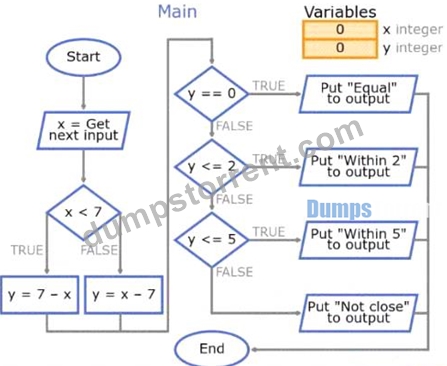
What is the output of the input is 7?
- A. Within 5
- B. Not close
- C. Within 2
- D. Equal
Answer: B
Explanation:
* Start with the input value (in this case, 7).
* Follow the flowchart's paths and apply the operations as indicated by the symbols and connectors.
* The rectangles represent processes or actions to be taken.
* The diamonds represent decision points where you will need to answer yes or no and follow the corresponding path.
* The parallelograms represent inputs/outputs within the flowchart.
* Use the input value and apply the operations as you move through the flowchart from start to finish.
References:
* Flowchart analysis is based on the understanding of flowchart symbols and their meanings, which can be found in resources such as ASQ's guide to flowcharts1 and Asana's explanation of flowchart symbols2.
To determine the correct answer, you would need to apply the input value of 7 to the flowchart and follow the steps until you reach the end, noting the output value. If you encounter any decision points, evaluate the condition with the current value and choose the path accordingly. By the end of the flowchart, you should have the final output value which corresponds to one of the options provided.
I hope this helps you in analyzing the flowchart and finding the correct output! If you have any more questions or need further assistance, feel free to ask.
NEW QUESTION # 22
What is the out of the given pseudocode?
- A. 0
- B. 1
- C. 2
- D. 3
Answer: A
Explanation:
The pseudocode provided appears to be a loop that calculates the sum of numbers. Without seeing the exact pseudocode, I can deduce based on common programming patterns that if the loop is designed to add numbers from 1 to 5, the sum would be 1 + 2 + 3 + 4 + 5, which equals 15. This is a typical example of a series where the sum of the first n natural numbers is given by the formula
2n(n+1)
, and in this case, with n being 5, the sum is
25(5+1)=15
NEW QUESTION # 23
The steps in an algorithm to calculate the positive difference in given values, x and y, are given in no particular order:
* Put Diff to output.
* Set Diff = x - y.
* If y > x, set Diff = y - x.
* Declare variable Diff.What is the first step of the algorithm?
- A. If y > x, set Diff = y - x.
- B. Declare variable Diff.
- C. Put Diff to output.
- D. Set Diff = x - y.
Answer: B
Explanation:
Comprehensive and Detailed Explanation From Exact Extract:
The algorithm calculates the positive difference between x and y (i.e., |x - y|). According to foundational programming principles, an algorithm's steps must be executed in a logical order, and variables must be declared before they are used.
* Steps Analysis:
* Declare variable Diff: Creates the variable Diff to store the result. Must occur first, as other steps use Diff.
* Set Diff = x - y: Computes the difference, assuming x >= y. Requires Diff to exist.
* If y > x, set Diff = y - x: Adjusts Diff to ensure it's positive if y > x. Requires Diff to exist.
* Put Diff to output: Outputs the final result. Must occur last, after Diff is computed.
* Logical Order:
* Declare Diff (create variable).
* Set Diff = x - y (initial difference).
* If y > x, set Diff = y - x (ensure positive).
* Output Diff.
* Option A: "Put Diff to output." Incorrect. Outputting Diff requires it to be computed, which happens after declaration and calculation.
* Option B: "Set Diff = x - y." Incorrect. Setting Diff requires Diff to be declared first.
* Option C: "If y > x, set Diff = y - x." Incorrect. This step uses Diff, so declaration must precede it.
* Option D: "Declare variable Diff." Correct. Declaring Diff is the first step, as all other steps depend on Diff existing.
Certiport Scripting and Programming Foundations Study Guide (Section on Algorithms and Variables).
Python Documentation: "Variable Declaration" (https://docs.python.org/3/reference/simple_stmts.
html#assignment-statements).
W3Schools: "C Variables" (https://www.w3schools.com/c/c_variables.php).
NEW QUESTION # 24
A team of programmers describes the objects and functions in a program that compresses files before splitting the objects.
Which two waterfall approach phases are involved?
- A. Design and testing
- B. Analysis and implementation
- C. Design and implementation
- D. Implementation and testing
Answer: C
Explanation:
The Waterfall Model is a sequential design process used in software development, where progress is seen as flowing steadily downwards through several phases like a waterfall. In the context of the question, describing the objects and functions in a program that compresses files before splitting the objects involves two specific phases:
* Design Phase: This is where the system's architecture, components, interfaces, and data are all defined.
The team would design the objects and functions necessary for the file compression program during this phase.
* Implementation (or Development) Phase: Following the design, the actual code is written during the implementation phase. The objects and functions described in the design phase are created and tested to ensure they work as intended.
These two phases are critical in the Waterfall approach for transitioning from an abstract understanding of the problem to a concrete implementation in code. The analysis phase is more about understanding the problem and requirements, while testing is a separate phase that comes after implementation.
References:
* GeeksforGeeks article on Waterfall Model1.
* Built In's explanation of Waterfall Methodology2.
* Forbes Advisor's overview of Waterfall Methodology3.
NEW QUESTION # 25
Which line is a loop variable update statement in the sample code?
integer h = 0
do
Put "What is the password?" to output
String userInput = Get next input
if userInput != pwd
Put "Incorrect." to output
h = h + 1
while (userInput != pwd) and (h <= 10)
if userInput = pwd
Put "Access granted." to output
else
Put "Access denied." to output
- A. integer h = 0
- B. h = h + 1
- C. (userInput != pwd) and (h <= 10)
- D. if userInput = pwd
Answer: B
Explanation:
Comprehensive and Detailed Explanation From Exact Extract:
The loop variable update statement modifies the loop control variable to progress the loop. In this do-while loop, h tracks the number of attempts, and its update is critical to the loop's termination. According to foundational programming principles, the update statement is typically within the loop body.
* Code Analysis:
* integer h = 0: Initializes h (not an update).
* Put "What is the password?" to output: Outputs prompt (not an update).
* String userInput = Get next input: Gets input (not an update).
* if userInput != pwd: Conditional check (not an update).
* Put "Incorrect." to output: Outputs message (not an update).
* h = h + 1: Updates h, incrementing the attempt counter.
* while (userInput != pwd) and (h <= 10): Loop condition (not an update).
* Option A: "if userInput = pwd." Incorrect. This is a conditional statement, not an update. (Note: The code uses = for comparison, which may be a typo; == is standard.)
* Option B: "h = h + 1." Correct. This updates the loop variable h, incrementing it to track attempts.
* Option C: "(userInput != pwd) and (h <= 10)." Incorrect. This is the loop condition, not an update.
* Option D: "integer h = 0." Incorrect. This is the initialization, not an update.
Certiport Scripting and Programming Foundations Study Guide (Section on Loops and Variables).
C Programming Language Standard (ISO/IEC 9899:2011, Section on Do-While Loops).
W3Schools: "C Do While Loop" (https://www.w3schools.com/c/c_do_while_loop.php).
NEW QUESTION # 26
The steps in an algorithm to calculate the positive difference in two given values, x and y, are given in no particular order: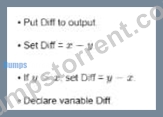
What is the first step of the algorithm?
- A. If y > x, set Diff = y - x.
- B. Set Diff = x - y
- C. Deduce variable Diff
- D. Put Diff to output
Answer: C
Explanation:
The first step in the algorithm to calculate the positive difference between two given values, x and y, is to declare the variable Diff. This is essential as it initializes the variable that will be used to store the calculated difference between x and y. The subsequent steps involve conditional statements and arithmetic operations that utilize this declared variable to compute and store the positive difference. References: N/A (as per image provided) The image shows steps of an algorithm listed in no particular order for calculating the positive difference between two values, making it relevant for understanding or teaching algorithmic logic and sequence.
NEW QUESTION # 27
A sequence diagram is shown: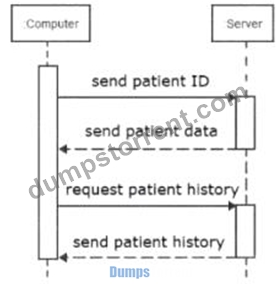
What is the purpose of a sequence diagram?
- A. It outlines the needed computations.
- B. It outlines the potential actions of a user
- C. It depicts program operations, branches, and loops.
- D. It illustrates the communication steps for a particular software scenario.
Answer: D
Explanation:
A sequence diagram is a type of interaction diagram that details how operations are carried out within a system. It is used to model the interactions between objects or components in a sequence that reflects the order of operations, particularly focusing on the messages exchanged between these objects over time. The vertical axis of a sequence diagram represents time, and the horizontal axis represents the objects involved in the interaction. The purpose of a sequence diagram is to illustrate the sequence of messages or events that occur between these objects, typically in the context of a specific use case or scenario within the software system1234.
References:
* The information provided is based on standard practices in software engineering and UML (Unified Modeling Language) documentation. For further reading on sequence diagrams and their applications, you can refer to resources such as Visual Paradigm1, Creately2, IBM Developer3, and Lucidchart4.
NEW QUESTION # 28
What is one characteristic of an object-oriented language that is not a characteristic of a procedural or functional language?
- A. The language is optimized for recursive programming.
- B. The language treats programs as evaluating mathematical functions.
- C. The language is based on the concept of modular programming and the calling of a subroutine.
- D. The language supports decomposing a program into objects that interact with one another.
Answer: D
Explanation:
One of the fundamental characteristics of object-oriented programming (OOP) is the concept of decomposing a program into objects that interact with one another1. This is distinct from procedural and functional programming paradigms, which do not inherently structure programs as a collection of objects. In OOP, objects are instances of classes and contain both data (attributes) and code (methods). These objects encapsulate data and operations and can interact with each other through methods, allowing for concepts such as inheritance, polymorphism, and encapsulation12.
In contrast, procedural programming is characterized by a focus on procedures or routines to perform tasks, and functional programming treats computation as the evaluation of mathematical functions without side effects or state changes2. Neither paradigm organizes code around objects with encapsulated data and methods, which is a defining feature of OOP1.
References: 1: Differences between Procedural and Object Oriented Programming - GeeksforGeeks 2:
Functional vs. Procedural vs. OOP | Scout APM
NEW QUESTION # 29
What is one task that could be accomplished using a while loop?
- A. A user is asked to enter a password repeatedly until either a correct password is entered or five attempts have been made.
- B. The user inputs an integer, and the program prints out whether the number is even or odd and whether the number is positive, negative, or zero.
- C. When the user inputs a number, the program outputs "True" when the number is a multiple of 10.
- D. After inputting two numbers, the program prints out the larger of the two.
Answer: A
Explanation:
Comprehensive and Detailed Explanation From Exact Extract:
A while loop repeatedly executes a block of code as long as a condition is true, making it suitable for tasks requiring iteration until a condition changes. According to foundational programming principles, while loops are ideal for scenarios with an unknown number of iterations or conditional repetition.
* Option A: "When the user inputs a number, the program outputs 'True' when the number is a multiple of
10." This is incorrect. This task requires a single check (number % 10 == 0), which can be done with an if statement, not a loop.
* Option B: "The user inputs an integer, and the program prints out whether the number is even or odd and whether the number is positive, negative, or zero." This is incorrect. This task involves a single input and multiple conditional checks, handled by if statements, not a loop.
* Option C: "After inputting two numbers, the program prints out the larger of the two." This is incorrect.
Comparing two numbers requires a single if statement (e.g., if (a > b)), not a loop.
* Option D: "A user is asked to enter a password repeatedly until either a correct password is entered or five attempts have been made." This is correct. This task requires repeated input until a condition is met (correct password or five attempts), which is ideal for a while loop. For example, in Python:
attempts = 0
while attempts < 5 and input("Password: ") != "correct":
attempts += 1
Certiport Scripting and Programming Foundations Study Guide (Section on Control Structures: Loops).
Python Documentation: "While Statements" (https://docs.python.org/3/reference/compound_stmts.
html#while).
W3Schools: "C While Loop" (https://www.w3schools.com/c/c_while_loop.php).
NEW QUESTION # 30
An algorithm should output ''OK'' if a number is between 98.3 and 98.9, else the output is ''Net OK'' Which test is a valid test of the algorithm?
- A. Input 98.6. Ensure output is "OK "
- B. Input 99.9. Ensure output is "OK"
- C. Input 99.9. Ensure output is M98 9 "
- D. Input 98.6. Ensure output is "Not OK ''
Answer: A
Explanation:
The algorithm is designed to output "OK" if the input number is within the range of 98.3 to 98.9. Therefore, the valid test would be one that checks if the algorithm correctly identifies a number within this range and outputs "OK". Option B provides an input of 98.6, which falls within the specified range, and expects the correct output of "OK", making it a valid test case for the algorithm.
References: The principles of testing algorithms involve checking for correct outputs given specific inputs, particularly testing normal, boundary, and invalid cases to ensure the algorithm behaves as expected12. In this scenario, the input 98.6 is a normal case within the specified range, and the expected output is "OK" as per the algorithm's design criteria3.
1: Stack Overflow - How to decide test cases for unit tests? 2: Analytics Vidhya - Writing Test Cases for Machine Learning systems 3: LinkedIn - How to Choose the Best Test Cases for Your Algorithm
NEW QUESTION # 31
What is the outcome for the given algorithm? Round to the nearest tenth, if necessary.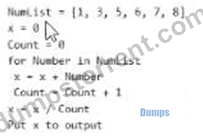
- A. 6.0
- B. 5.0
- C. 8.4
- D. 6.1
Answer: B
Explanation:
* Initialize two variables: x and Count to zero.
* Iterate through each number in the NumList.
* For each number in the list:
* Add the number to x.
* Increment Count by one.
* After processing all numbers in the list, calculate the average:
* Average = x / Count.
The NumList contains the following integers: [1, 3, 5, 6, 7, 8].
Calculating the average: (1 + 3 + 5 + 6 + 7 + 8) / 6 = 30 / 6 = 5.0.
However, none of the provided options match this result. It seems there might be an error in either the options or the calculation.
NEW QUESTION # 32
Consider the given flowchart.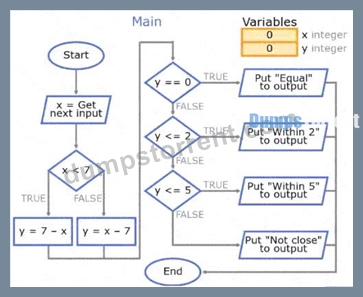
What is the output of the input is 7?
- A. Within 5
- B. Not close
- C. Within 2
- D. Equal
Answer: B
Explanation:
* Start with the input value (in this case, 7).
* Follow the flowchart's paths and apply the operations as indicated by the symbols and connectors.
* The rectangles represent processes or actions to be taken.
* The diamonds represent decision points where you will need to answer yes or no and follow the corresponding path.
* The parallelograms represent inputs/outputs within the flowchart.
* Use the input value and apply the operations as you move through the flowchart from start to finish.
NEW QUESTION # 33
The steps in an algorithm to buy a pair of shoes from a store are given in no particular order.
* Bring the shoes to the cashier
* Pay for the shoes
* Enter the store
* Select the pair of shoes
What is the first step of the algorithm?
- A. Select the pair of shoes.
- B. Pay for the shoes.
- C. Bring the shoes to the cashier.
- D. Enter the store
Answer: D
Explanation:
An algorithm is a set of step-by-step instructions for completing a task. In the context of buying a pair of shoes from a store, the first logical step would be to enter the store. This is because one cannot select a pair of shoes, bring them to the cashier, or pay for them without first entering the store. The steps should follow a logical sequence based on the dependencies of each action:
* Enter the store - This is the initial step as it allows access to the shoes available for purchase.
* Select the pair of shoes - Once inside, the next step is to choose the desired pair of shoes.
* Bring the shoes to the cashier - After selection, the shoes are taken to the cashier for payment.
* Pay for the shoes - The final step is the transaction to exchange money for the shoes.
References:
* The concept of algorithms and their properties can be found in computer science and programming literature, such as "Introduction to Algorithms" by Cormen, Leiserson, Rivest, and Stein.
* The logical ordering of steps in a process is a fundamental aspect of algorithm design, which is covered in foundational programming and scripting courses.
NEW QUESTION # 34
Oder the tasks needed to safely replace a lamp's light bulb from first (1) to last (4).
Select your answer from the pull down list.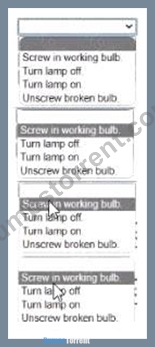
Answer:
Explanation: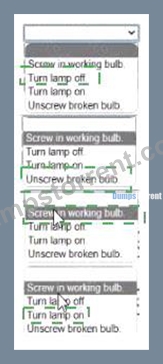
Explanation: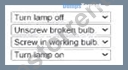
Safety and proper procedure are paramount when replacing a light bulb to avoid any electrical hazards or injuries. First, always ensure the lamp is turned off to prevent electrical shock. Next, carefully unscrew the broken or burnt-out bulb from the socket; it might be hot, so caution is advised. After removing the old bulb, screw in the new working bulb securely but without overtightening to avoid damaging the bulb or socket.
Finally, turn the lamp on to verify that the new bulb is functioning properly.
References The answer and explanation are based on general knowledge and common safety practices for handling electrical appliances; specific documents or standards on Scripting and Programming Foundations are not applicable here.
The image displays multiple-choice options for ordering tasks needed to safely replace a lamp's light bulb, providing an interactive learning method for understanding safety procedures in handling electrical items.
NEW QUESTION # 35
......
The Ultimate WGU Scripting-and-Programming-Foundations Dumps PDF Review: https://www.dumpstorrent.com/Scripting-and-Programming-Foundations-exam-dumps-torrent.html
Updated Verified Scripting-and-Programming-Foundations Downloadable Printable Exam Dumps: https://drive.google.com/open?id=1AjJ7jUg7RtGvLeLUa8gnO9y9CMTPpinO