

Pass Your Supply Chain Planning Cloud 1z0-1066-22 Exam on Aug 21, 2023 with 111 Questions
1z0-1066-22 Free Exam Study Guide! (Updated 111 Questions)
NEW QUESTION # 18
Your client wants to create a supply plan that only considers sales order and disregards forecast demand within a specific demand horizon. What must you do to accomplish this?
- A. Manage Plans > Search and select demand plan > Demand tab > General tab > Select 'Do no spread forecast'
- B. Manage Plans > Search and select supply plan > Supply tab > Organizations and Schedules tab > Remove all demand schedules
- C. Manage Plans > Search and select demand plan > Demand tab > General tab > Check Demand Time Fence Control
- D. Manage Plans > Search and select supply plan > Supply tab > General tab > Advanced Options > Check 'Create time fence'
- E. Manage Plans > Search and select supply plan > Supply tab > General tab > Check Demand Time Fence Control
Answer: E
NEW QUESTION # 19
Your client has a requirement to restrict Supply Plan data access. Identify three Data Access Set detail entities that can be used to restrict plan data access. (Choose three.)
- A. Customer
- B. Supplier
- C. Material Planner
- D. Item
- E. Demand Class
- F. Transaction Type
Answer: A,B,D
Explanation: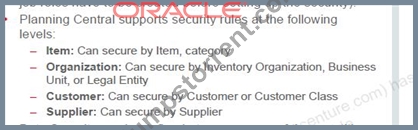
NEW QUESTION # 20
When analyzing demand fulfillment, what are the three types of recommendations that users can review and accept for expediting? (Choose three.)
- A. Expedite drop ship orders
- B. Expedite buy orders
- C. Expedite make orders
- D. Expedite transfer orders
- E. Expedite make to stock orders
Answer: B,C,D
NEW QUESTION # 21
Identify two ways you can track performance against goals when defining measure goals. (Choose two.)
- A. Value
- B. Range
- C. Aggregation
- D. Quantity
- E. Specification
- F. Attribute
Answer: A,F
NEW QUESTION # 22
Your client manufactures consumer electronics and has all facilities live on Oracle Cloud. Their latest product has a very complicated manufacturing process and therefore can only be made at one facility (Organization ABC). However, it is ordered all over the world.
How should the Sourcing Rule be set up to accomplish this?
- A. A local sourcing rule for 100% make at ABC; a global sourcing rule for 100% transfer from ABC
- B. A global sourcing rule for 100% make at ABC; a local sourcing rule for 100% transfer from ABC
- C. A global sourcing rule for 50% make at ABC and 50% buy from ABC
- D. A local sourcing rule for 100% buy from ABC; a global sourcing rule for 100% transfer from ABC
- E. A local sourcing rule for 100% make at ABC; a global sourcing rule for 100% buy from ABC
Answer: D
NEW QUESTION # 23
It is now January 2023. Your customer has loaded 3 years worth of shipment history (for 1/1/20 through 12/31/22) and wants to generate a monthly forecast for 2023 based on two years of shipment history.
When creating a demand plan, which two plan scope and demand plan options should your customer use? (Choose two.)
- A. For plan scope, select plan horizon as 12 months, forecasting calendar as Gregorian, and forecasting time level as month.
- B. For demand plan option, add forecast shipments as forecasting profile, enter history start date as 1/1/21. forecast start date as 1/1/23. and enter forecast end date as 12/31/23.
- C. For plan scope, select plan horizon days as 365. forecasting calendar as Gregorian, and forecasting time level as month.
- D. For demand plan option, add forecast shipments as forecasting profile, enter historical buckets as 24. and enter forecast buckets as 12.
- E. For demand plan option, add forecast shipments as forecasting profile, and enter historical buckets as 24.
- F. For demand plan option, add forecast shipments as forecasting profile, enter history start date as 1/1/21. enter history end date as 12/31/22. and enter forecast start date as 1/1/23.
Answer: A,D
NEW QUESTION # 24
You are a demand planner and you want to generate forecast for all laptop and desktop products in the US business unit. You are using standard enterprise and product hierarchy. You have created a demand plan and now you must define plan scope.
Identify three valid steps. (Choose three.)
- A. For plan organizations, select hierarchy as enterprise, level as country, and US as level member.
- B. For forecasting items, select hierarchy as product, level as product, and all laptop and desktop products as level members.
- C. For forecasting items, select hierarchy as product, level as category level 1, and laptop and desktop categories as level members.
- D. For plan organizations, select hierarchy as enterprise, level as business unit, and US and level member.
- E. For plan parameters, select forecasting calendar as Gregorian and time level as month.
- F. For plan parameters, select forecasting calendar as Gregorian and time level as week.
Answer: A,C,F
Explanation: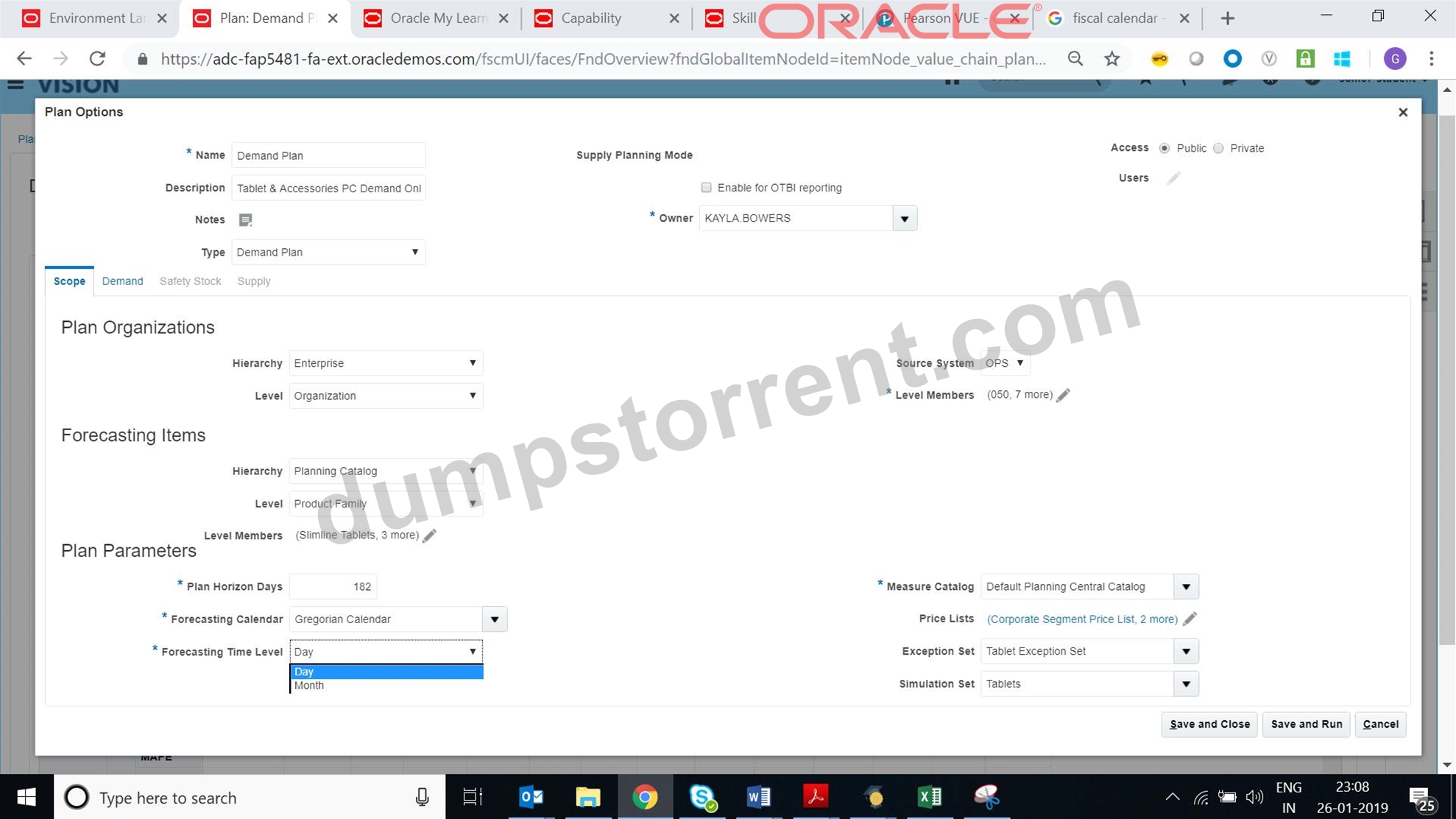
NEW QUESTION # 25
Which two statements are true regarding Planning Business Flows? (Choose two.)
- A. Inventory Planning cannot run in the Planning Business Flows.
- B. Planners can set up automatic release rules or release orders manually as part of the plan execution.
- C. You can analyze and adjust data at any stage of the process.
- D. Demand and Supply Planning have to be run in separate business flows.
- E. In automated plans, all release rules must be automatic.
Answer: B,C
NEW QUESTION # 26
You ran a demand plan with the data refresh option "Do not refresh with current data." Identify two true statements. (Choose two.)
- A. Shipments history data will be updated.
- B. Shipments forecast data will not be modified.
- C. Forecasting engine will not run.
- D. Forecasting engine will run without advancing the plan date.
- E. Shipments history data will not be modified.
Answer: D,E
NEW QUESTION # 27
Which two statements are true about the seeded (predefined) Contract Manufacturing roles? (Choose two.)
- A. Users with the Supplier Inventory Manager role don't need access to the Supplier Portal because they already have access to the Supply Chain Collaboration work area.
- B. Users with the Supply Chain Operations Manager role can access the Supply Chain Collaboration work area.
- C. Users with the Contract Manufacturer role can access the Supplier Portal to upload their production updates.
- D. Users with the Supply Chain Operations Manager role need access to the Supplier Portal to see their updates and what's in progress.
- E. Users with the Supplier Inventory Manager role can access the Supplier Portal.
Answer: B,E
NEW QUESTION # 28
You are setting up the plan page layout for your customer.
In which of these requirements would you use an Infotile?
- A. Showing inventory values by product category
- B. Showing on-hand value compared to targets
- C. Showing inventory value across time
- D. Showing a breakdown of exception in a pie chart
- E. Showing customer demand trend over a specific time period
Answer: C
NEW QUESTION # 29
Which three statements are true regarding Managing Units of Measure? (Choose three.)
- A. Non-standard, intraclass conversion rates can't be item specific.
- B. If you want to transact items in units of measure that belong to classes other than their primary UOM class, you must also define conversions between the base units of measure of the different UOM classes.
- C. A unit of measure conversion is a mathematical relationship between two different units of measure.
- D. You must define a unit of measure class with a base unit of measure.
- E. A unit of measure standard conversion specifies the conversion factor by which the unit of measure is equivalent to the unit of measure class.
Answer: B,C,D
NEW QUESTION # 30
During an implementation, customer is in the process of planning supply requirements. Customer also needs to generate forecast and safety stock levels. Which plan type on the plan options should the customer be running?
- A. Supply Plan
- B. Safety Stock and Forecast Plan
- C. Demand Plan
- D. Demand and Supply Plan
- E. Integrated Plan
Answer: D
NEW QUESTION # 31
Your client has reviewed all of the current graphs available for the plans, but cannot find one that shows them exactly what they want for the Days of Supply. How can this key performance indicator be added?
- A. Open the plan and go to Actions > Manage Tables, Graphs, and Analysis Sets, and add a new graph with the requested data.
- B. Go to Configure Planning Analytics > Actions > Manage Tables, Graphs, and Analysis Sets, and edit the current 'Days of Supply' graph to meet the client needs.
- C. It is not possible to add new or change the current graphs.
- D. Open the plan and go to Actions > Manage Tables, Graphs, and Analysis Sets, and edit the current 'Days of Supply' graph to meet the client needs.
- E. Go to Configure Planning Analytics > Actions > Manage Tables, Graphs, and Analysis Sets, and add a new graph with the requested data.
Answer: A
NEW QUESTION # 32
Which statement applies only to the planning of back-to-back items and not standard items?
- A. Must have added sourcing rules to the Global Order Promising assignment set.
- B. Planning collects bookings or shipments history to forecast items.
- C. Planning analyzes supply shortages and capacity overloads using any of the standard planning tools.
- D. Must use Global Order Promising and Supply Chain Orchestration to release and create new supplies
- E. Planning pegs reserved supplies to sales orders.
Answer: D
Explanation: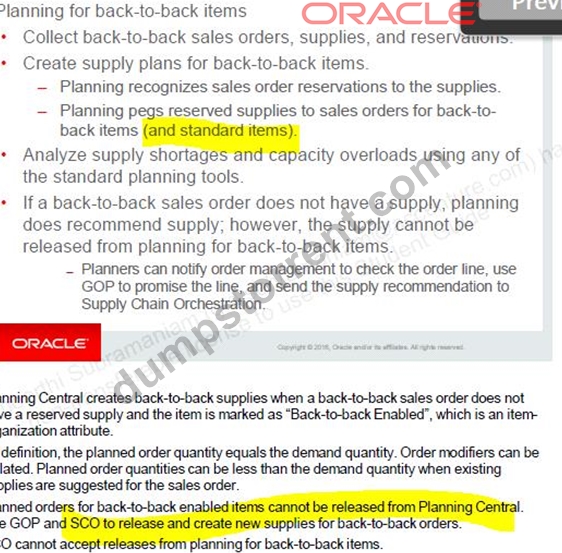
NEW QUESTION # 33
Your customer has loaded shipment history of 1/1/14 through 12/31/16 and wants to generate a monthly forecast of 1/1/17 through 12/31/17 based on two-year shipment history.
When creating a demand plan, which two plan scopes and demand plan options should your customer use? (Choose two.)
- A. For demand plan option, add forecast shipments as forecasting profile, enter history start date as 1/1/15, forecast start date as 1/1/17, and enter forecast end date as 12/31/17.
- B. For demand plan option, add forecast shipments as forecasting profile, enter history start date as 1/1/15, enter history end date as 12/31/15, and enter forecast start date as 1/1/17.
- C. For demand plan option, add forecast shipments as forecasting profile, enter historical buckets as 24, and enter forecast buckets as 12.
- D. For plan scope, select plan horizon as 12 months, forecasting calendar as Gregorian, and forecasting time level as month.
- E. For demand plan option, add forecast shipments as forecasting profile, and enter historical buckets as 24.
- F. For plan scope, select plan horizon days as 365, forecasting calendar as Gregorian, and forecasting time level as month.
Answer: C,F
Explanation: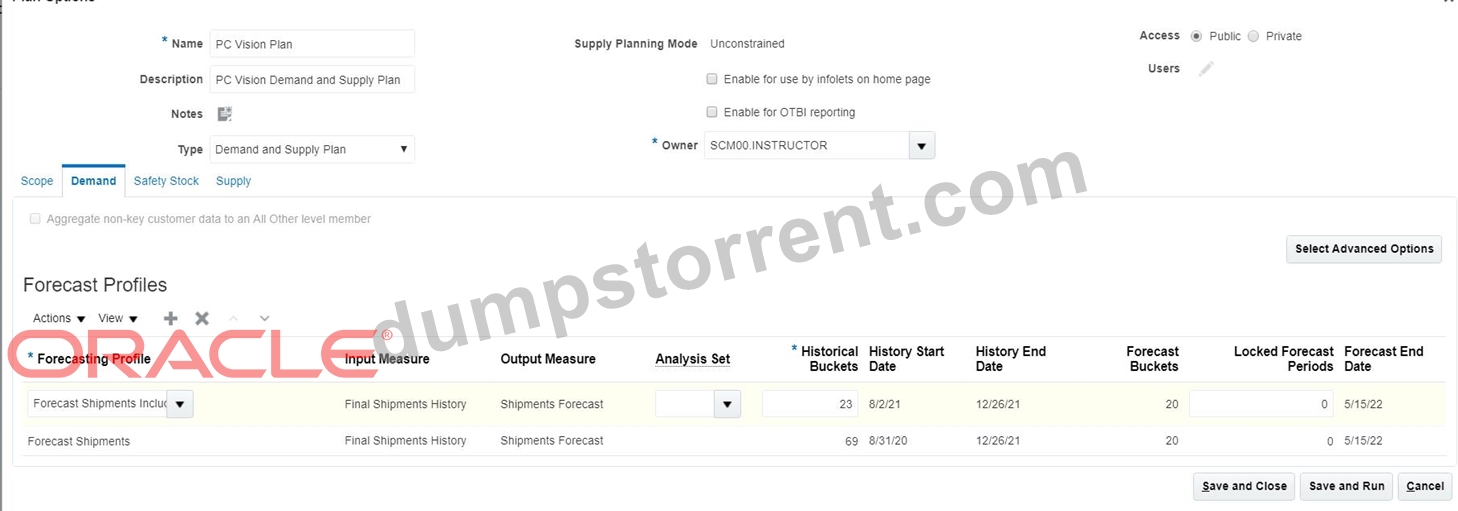
NEW QUESTION # 34
Which statement applies only to the planning of back-to-back items and not standard items?
- A. Must have added sourcing rules to the Global Order Promising assignment set.
- B. Planning collects bookings or shipments history to forecast items.
- C. Planning analyzes supply shortages and capacity overloads using any of the standard planning tools.
- D. Must use Global Order Promising and Supply Chain Orchestration to release and create new supplies
- E. Planning pegs reserved supplies to sales orders.
Answer: D
Explanation: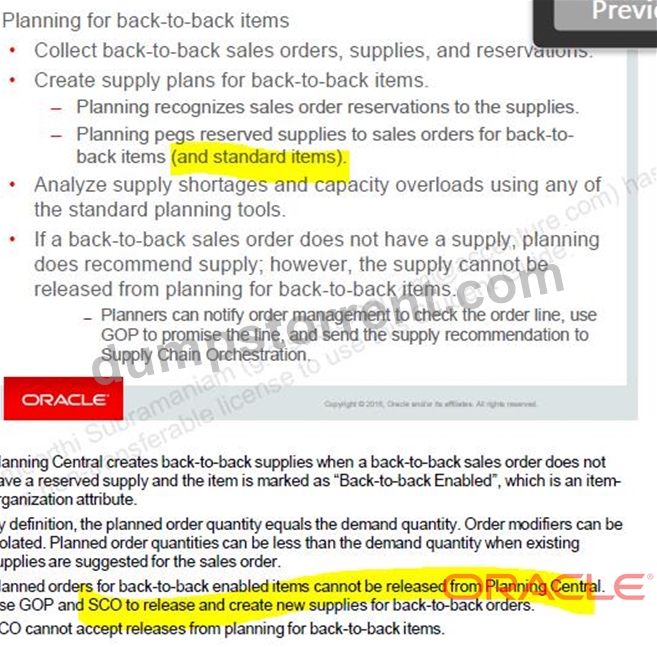
NEW QUESTION # 35
Which two statements are true when using Measure catalogs? (Choose two.)
- A. The measure catalog has a collection of measures that you can enable for use in a single plan in the Planning Central work area.
- B. You can restrict access to Measure Catalogs using Administer Data Security.
- C. Measure catalogs are defined in the system to improve the performance of the plan.
- D. You navigate to Configure Measure Catalogs to edit the Catalog.
- E. You can add or remove measures from a measure catalog.
- F. The predefined measure catalog is not the system default.
Answer: A,E
Explanation:
Reference: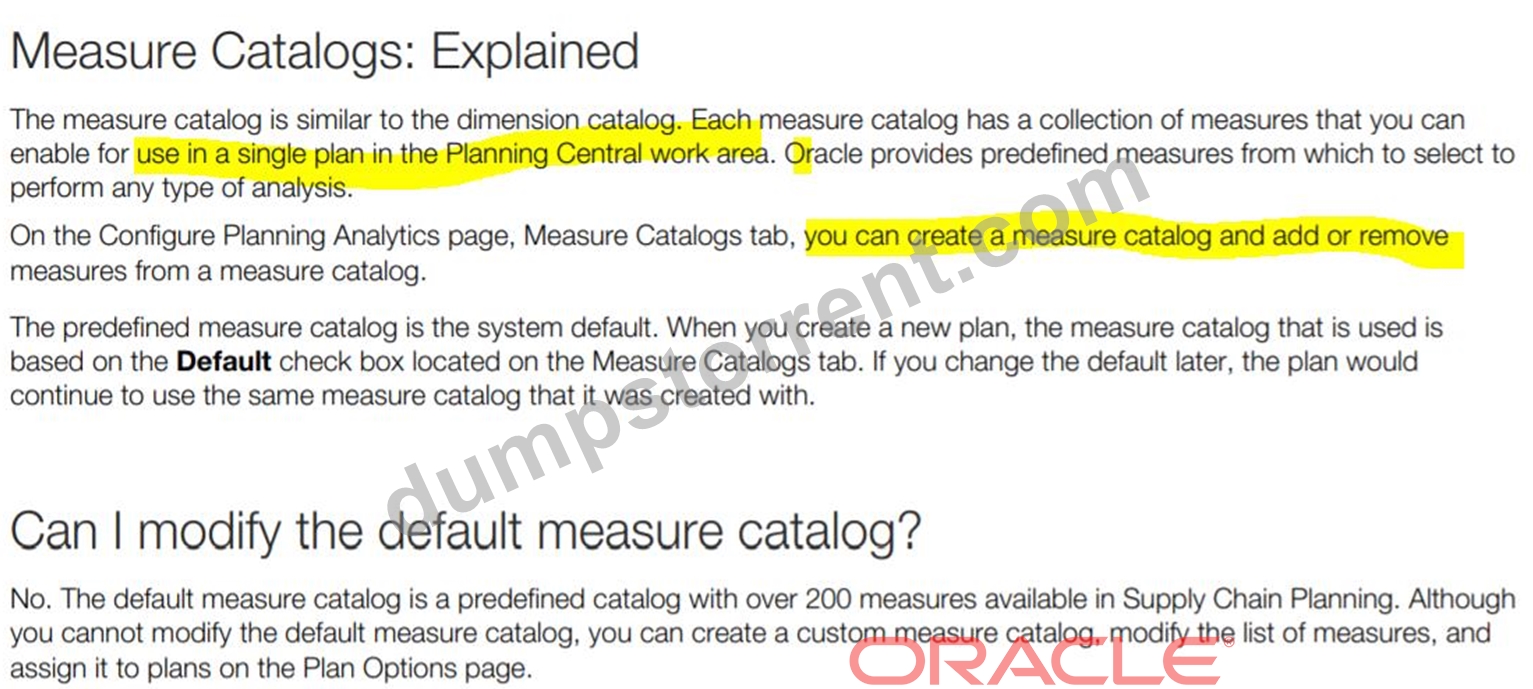
NEW QUESTION # 36
You are viewing a drop shipment plan for your organization and you want to know which customer the purchase order will be shipped to. Where can you see that?
- A. It is visible in the drop ship analytics.
- B. You can see the customer on the supply in Supplies and Demand.
- C. You can see the supplier on the sales order, but not vice-versa.
- D. You need to first drill down to the sales order from the supply-demand link, then open the sales order to get the customer.
- E. It is not viewable at this time.
Answer: D
NEW QUESTION # 37
The marketing department of a company needs to analyze the forecast based on type of demand (large retailer versus specialty store) and item cost (low versus high).
After creating a segment group with demand class and product for segment granularity, what additional sequence of actions must they also perform to satisfy marketing?
- A. Define four segments based on demand type and item cost, execute segmentation, and use the selector tool to create a new table or graph.
- B. Define four segmentation based on demand type and item cost, define each segment's criteria, execute segmentation, configure planning analytics to update the dimension catalog, and use the selector tool to create a new table or graph.
- C. Define two segments based on demand type and item cost, execute segmentation, and use the selector tool to create a new table or graph.
- D. Define four segments based on demand type and item cost, define each segment's criteria, execute segmentation, and use the selector tool to create a new table or graph.
Answer: D
NEW QUESTION # 38
......
Oracle 1z0-1066-22 certification exam is designed for professionals who want to prove their expertise in implementing Oracle Planning and Collaboration Cloud 2022. 1z0-1066-22 exam is intended for individuals who have a strong background in Cloud technologies and Oracle applications, and who are looking to advance their careers in the field of Cloud implementation. 1z0-1066-22 exam is designed to test the candidate's knowledge and skills in areas such as planning and forecasting, collaboration, and data management.
To take the Oracle 1z0-1066-22 exam, candidates must have a strong understanding of Oracle Planning and Collaboration Cloud 2022. They should have practical experience in implementing and managing the Oracle Cloud solution. Additionally, candidates must have completed the Oracle Planning and Collaboration Cloud 2022 Implementation Essentials course, which provides a foundation for the exam.
Oracle Planning and Collaboration Cloud 2022 Implementation Professional certification is highly valued within the technology industry. It is recognized as a benchmark of excellence in the field of cloud-based planning and collaboration solutions. Oracle Planning and Collaboration Cloud 2022 Implementation Professional certification provides professionals with a competitive edge in the job market and opens up new career opportunities.
1z0-1066-22 Dumps for Supply Chain Planning Cloud Certified Exam Questions and Answer: https://www.dumpstorrent.com/1z0-1066-22-exam-dumps-torrent.html
Realistic Verified 1z0-1066-22 exam dumps Q&As - 1z0-1066-22 Free Update: https://drive.google.com/open?id=1O0fxZqD-ZCmwmleXoIthuUGjF6GC_vBw